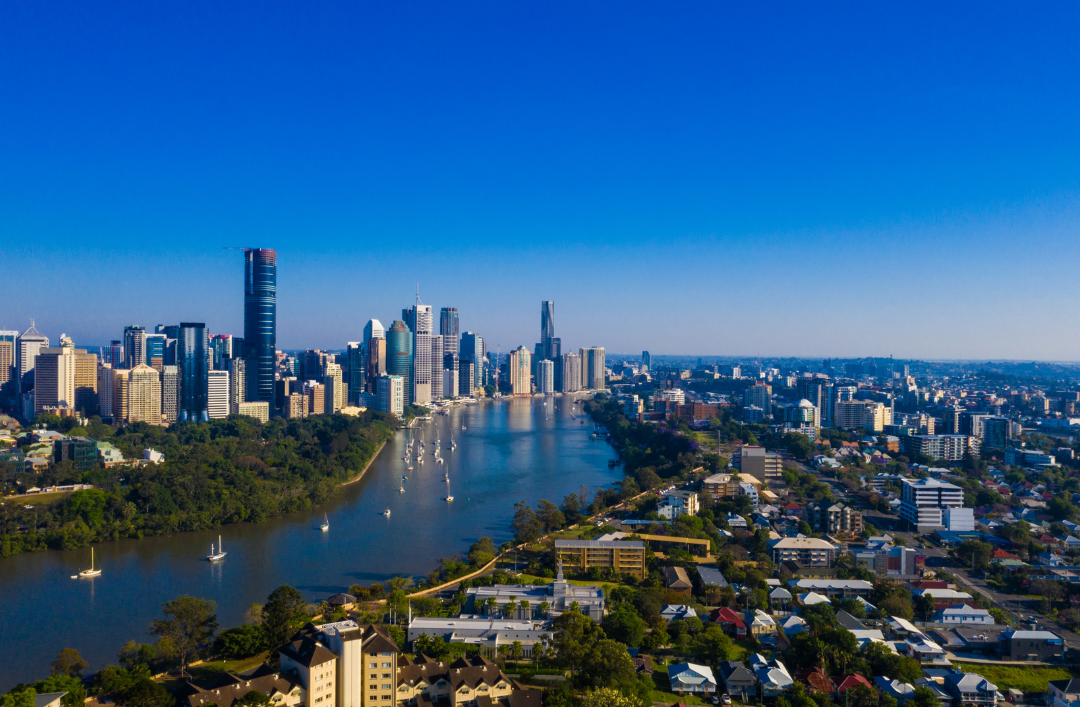
South Brisbane's moment has arrived.

In the last 24 hours, Brisbane's inner-city river corridor has seen a flurry of major public announcements. Institutional capital. Government commitment. Precinct-scale placemaking. All of it concentrated along one stretch of river, all of it pointing in the same direction.
This is not noise. It is the market arriving at a conclusion that careful observers have held for some time.
SEQ is adding 85,000 new residents every year. The region's population is projected to grow by 1.65 million by 2041. There is a $127 billion government and public infrastructure pipeline committed to the region, sitting alongside a $58 billion federal City Deal spanning two decades. Brisbane apartments have already delivered 39% growth over the past two years, outpacing Sydney at 8% and Melbourne at less than 1%. With a residential vacancy rate that has held at around 1% for more than three years, this is not a market running on sentiment. The fundamentals are structural.
Independent research is now putting precise numbers to that trajectory. A PRD report released this week shows Brisbane house prices up 14% to $1.15 million over the past 12 months, with units up 23% to $750,000. PRD chief economist Dr Diaswati Mardiasmo is forecasting a further 8 to 10% growth for houses and 16 to 18% for units over the next year, driven by what she describes as deep undersupply. Just 275 new houses are planned against more than 25,000 annual sales. The vacancy rate sits at 0.8%. Critically, she notes that even if interest rates rise further, the undersupply is sufficient to sustain price growth. Unlike Sydney and Melbourne, where values are beginning to stabilise, Brisbane's upward pressure is expected to persist.
Against that backdrop, what is happening along the South Brisbane riverfront matters even more.
For years, this stretch of the river, sitting between South Bank and West End less than two kilometres from the CBD, has been one of Brisbane's last significant patches of underutilised industrial land. That is now changing in a decisive way. Major mixed-use development is being planned for the area: thousands of new homes, riverfront promenades, public open space, and the kind of amenity infrastructure that reshapes how a neighbourhood functions for decades.
This is not a speculative proposal. It is government-backed, privately delivered, and on an Olympic timeline.
The supply picture makes the location even more compelling. Across inner Brisbane there is an estimated shortfall of around 24,000 apartments over the next four years. Completions are running well below trend, constrained by construction costs, labour, and approvals. Only premium product is clearing feasibility and getting out of the ground. South Brisbane, by its nature, captures an outsized share of demand in that environment: central, connected, amenity-rich, and with a riverfront that has been largely inaccessible to the public for a generation.
We have had active opportunities in this corridor for some time. That is not a coincidence. It reflects a view we formed years ago that the South Brisbane river edge was significantly underpriced relative to what it was becoming. This week's announcements are the market arriving at the same conclusion, publicly, and with serious capital behind it.
For clients already positioned here, this is confirmation of a long-term hold thesis. For those still considering it, the window to enter ahead of full repricing is narrowing.
Brisbane's river corridor is being redrawn. The decisions made now, on which precincts, which buildings, which positions, are the ones that will compound across the next decade and beyond.
We work upstream of the public market. This is exactly why.
Source: PRD Smart Moves: Capital Cities Edition 1st Half 2026, as reported by The Courier-Mail
Michael Wilkins is Director of Property at Nuestar. Nuestar is a specialist property advisory firm with offices in Sydney, Brisbane and Singapore. For more information visit nuestar.com.au